Sheet Pan Honey Harissa Salmon
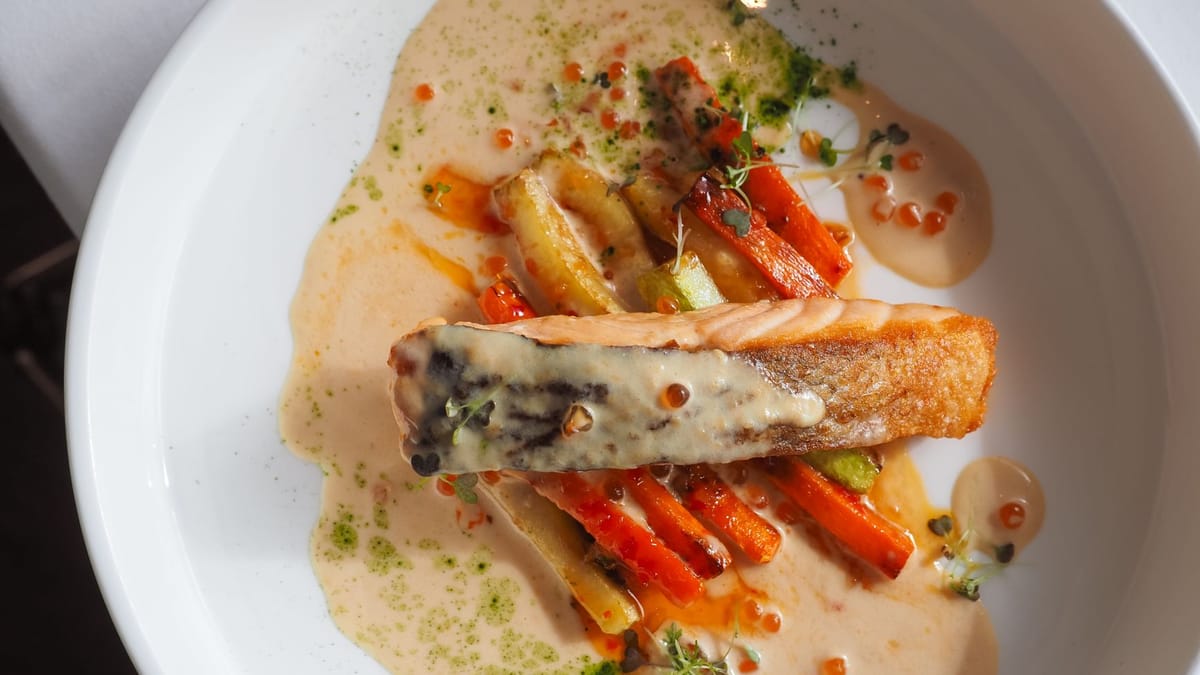
Honey and harissa do the same job here from opposite directions — one caramelises, the other brings heat and smoke. The whole thing cooks on one tray in about half an hour, most of which is the potatoes.
★ At a glance
- Serves: 4
- Prep: 15 minutes
- Roast: 30 minutes total
- Equipment: one large sheet pan; a probe thermometer helps
- Difficulty: easy
Why this version works
Salmon is easy to overcook and almost impossible to rescue afterwards, so the useful part of this recipe is the temperature, not the timing. Pull the fish at 50°C at the thickest point and it will carry over to a just-set, translucent centre while it rests.
The glaze goes on late and thin. Honey burns quickly at roasting temperature, so a heavy coating from the start gives you a bitter crust before the middle is done.
Ingredients
For the tray
- 4 salmon fillets, 150–170 g each, skin on
- 500 g baby potatoes, halved (or 2 courgettes, 1 red pepper and 1 red onion in large chunks)
- 2 tbsp olive oil
- Salt and black pepper
For the glaze
- 2 tbsp harissa paste, rose harissa if you can find it
- 1 tbsp honey
- 1 tbsp olive oil
- 1 garlic clove, grated
- Zest of 1 lemon and juice of half
- ½ tsp salt
To serve
- Thick yoghurt
- Chopped dill or coriander
- Lemon wedges
Method
- Heat the oven to 220°C / 425°F. Toss the potatoes with oil, salt and pepper and roast on a large sheet pan for 20 minutes. If you are using courgette and peppers instead, skip straight to step 3 — they only need the same time as the fish.
- Meanwhile, whisk the harissa, honey, oil, garlic, lemon zest and juice and salt together.
- Push the vegetables to the edges of the pan. Pat the salmon completely dry, sit it skin-side down in the middle and spoon the glaze over the tops.
- Roast for 8–12 minutes depending on thickness. Check at 8: 50°C / 125°F at the thickest point gives a just-translucent centre, 55°C / 130°F gives firmer, flakier fish.
- Rest for 3 minutes. Serve with a spoonful of cold yoghurt, the herbs and a lemon wedge — the yoghurt is there to cut the heat, so do not skip it.
Notes and substitutions
- Harissa varies enormously. Some brands are mild and smoky, others will take your head off. Taste yours first and scale up or down.
- No harissa? Mix 1 tbsp tomato purée, 1 tsp smoked paprika, ½ tsp cayenne, a pinch of ground cumin and a splash of oil.
- Honey can be maple syrup or pomegranate molasses; the molasses version is sharper and very good.
- Frozen salmon must be thawed fully and patted dry, otherwise it releases water and steams rather than roasts.
Storage and make-ahead
The glaze can be mixed three days ahead and kept in the fridge. Cooked salmon keeps two days and is better eaten cold — flaked into a grain salad — than reheated, which almost always takes it past done.
Questions people ask
How do I stop it drying out?
A thermometer. Fillet thickness varies far more than fillet weight, so timing alone is guesswork.
Skin on or off?
On. It shields the underside from the hot pan. It will not crisp under a wet glaze, and that is fine — lift the fish off it if you would rather not eat it.
Can I finish it under the grill?
For the last minute or two, watching constantly. Honey goes from glossy to burnt very fast.
Will this work with other fish?
Trout behaves almost identically. Cod and haddock need 2–3 minutes longer and a gentler hand when you move them.
About this recipe: written by the Bold Story editorial team from classic technique, given in metric and US measures. Times are a guide — pans, ovens and hob output vary, so cook to the cues described rather than to the clock. See our Editorial Policy.